

Ask us which mistake we see most often and the answer comes quickly: pricing the calendar so it looks tidy, instead of pricing every night for what it is worth. It feels sensible. It is also one of the most expensive habits in the business.
What It Looks Like
Saturday sells at 300 EUR and fills up weeks ahead. Sunday struggles at 60. The gap looks wrong on the screen, and sooner or later someone says it: “Can we not even this out a bit?” So Saturday goes down to 220 and Sunday goes up to 90. The calendar looks calm. The revenue does not.
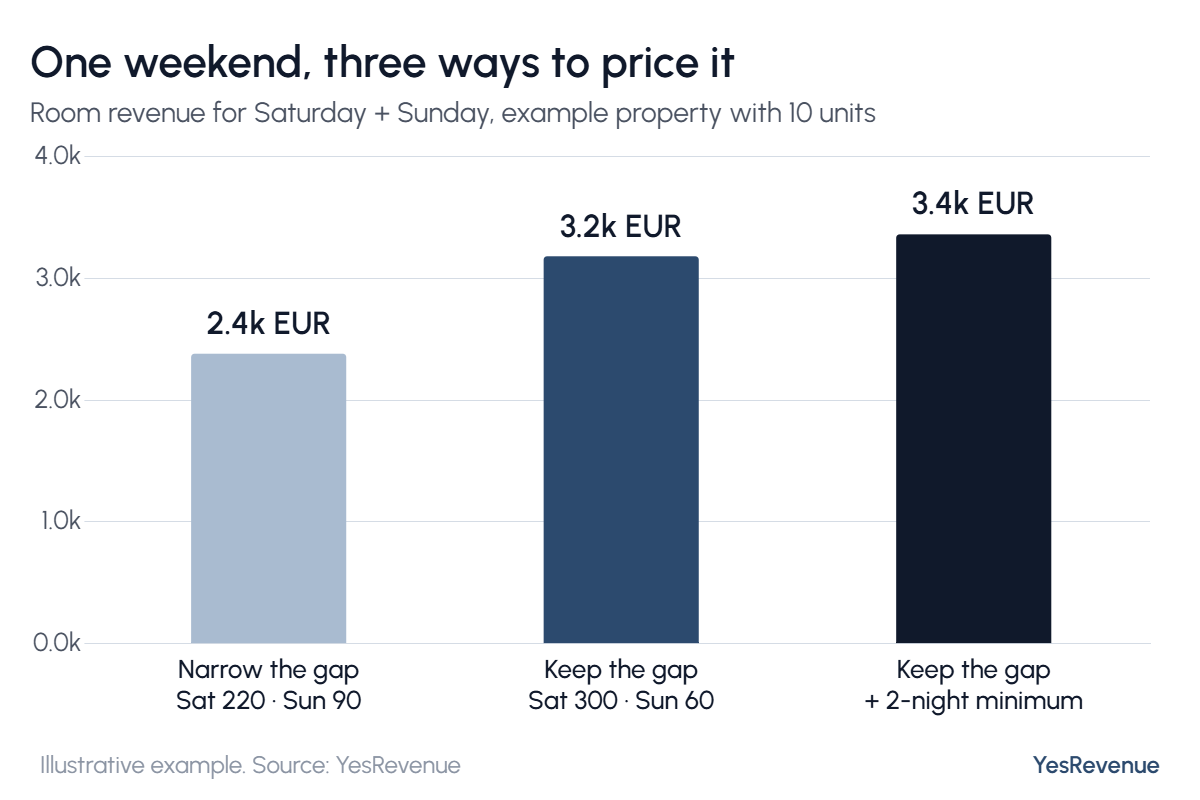
In this example the “even” weekend earns 2.4k EUR. Leaving the prices where demand put them earns 3.2k EUR. Keeping the gap and adding a two-night minimum for Saturday arrivals earns 3.4k EUR, because some of the Saturday guests now stay for Sunday too.
Why Smoothing Costs Money
Saturday and Sunday are different products. Saturday guests are not waiting for a cheaper rate; they come for the weekend and will pay for it. Lower the price and you simply hand them the difference. Sunday has the opposite problem: there are not enough guests, and a higher price makes that worse, not better.
Nothing about Sunday improves when Saturday gets cheaper. The two prices are separate decisions, each based on the demand for that night.
The Right Tool: Restrictions, Not Price
The knock-on effect of a big gap is real: a cheap Sunday can be booked on its own, and a strong Saturday can be broken up by one-night stays. The answer is not to bend the price. It is to set restrictions, separately from the price decision:
- A minimum stay on peak arrivals. Two nights for Saturday arrivals keeps your best night for guests who also fill a weaker one.
- Packages that bridge the gap. A three-night stay arriving on Friday covers Saturday and Sunday in one booking. A two-night offer arriving on Sunday fills the start of the week. A Thursday arrival, by the way, does nothing for Sunday.
- Restrictions that move with lead time. If a peak night is not filling, relax the minimum stay closer to arrival rather than dropping the rate.
Owners sometimes worry that a big gap looks odd to guests. In our experience guests understand that a Saturday in high season costs more. What really hurts is a Saturday that sold out three months ahead, at a price far below what guests were willing to pay.
Other Faces of the Same Mistake
- Dropping prices for the whole month because the first week is slow
- Matching a competitor’s rate on a night you are already almost full
- Pricing near-identical room types far apart, or very different ones the same
- Treating “the weekend” as one block, when Thursday, Friday, Saturday and Sunday all behave differently
They all come from the same instinct: making the numbers look neat instead of letting each date earn what it can.
A Quick Check for Your Own Calendar
- Which nights sell out earliest? Look back over the last year.
- Were those also your most expensive nights? If not, your price on those dates was too low.
- Where do strong and weak nights sit next to each other? That is where a minimum stay or a package can do more than a price change.
If you would like a second pair of eyes on your calendar, book a free Performance Assessment Call.