

We first shared these five steps in 2022, as a short slide deck. The basics have aged well. What has changed is how guests find a place to stay: in 2026 a growing share of trips start with a question to an AI assistant, not a search box. So here is the full version, written out properly and updated for the way people book now.
Updated October 2026.
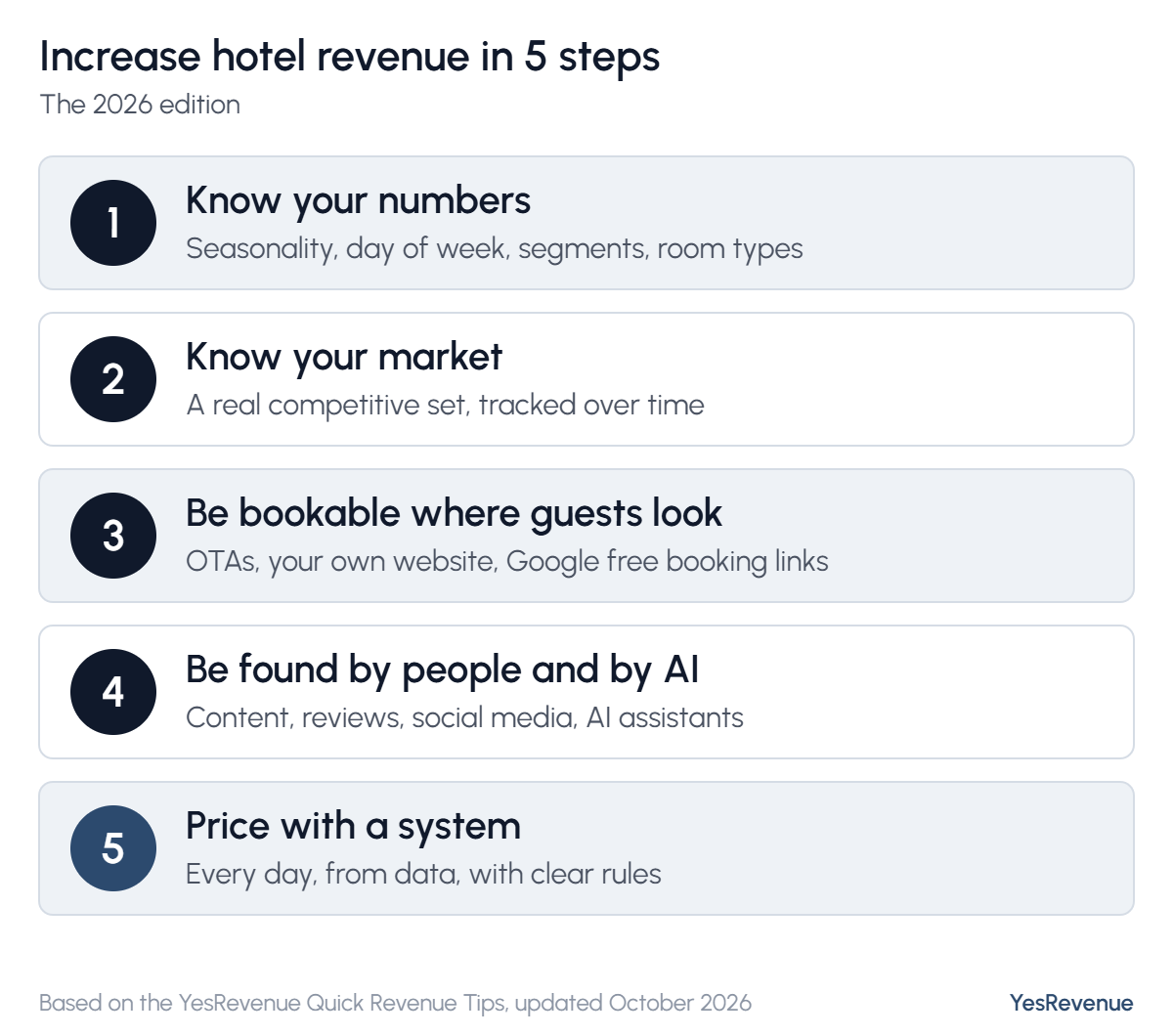
1. Know Your Numbers
Every good pricing decision starts with your own data, and most properties have more of it than they think. Before you change a single rate, look at three things:
- History. Occupancy and ADR per day for the last two years. Where is your seasonality, which days of the week are strong and which are weak?
- The future. What is already on the books for the coming months, per day? Are some periods filling faster than last year?
- Your mix. Who books you (direct, OTA, corporate, groups), what each segment pays, and which room types sell first.
That last point matters more than it sounds. If your family rooms sell out every summer weekend while the doubles go last, your supplements are probably too low. The room type data tells you where to set them.
In 2026 there is no reason to do this once a year in a spreadsheet. A simple dashboard connected to your PMS can show it every morning. That is exactly why we built MyHotelDash.
2. Know Your Market
Your competitive set is not every hotel in town. It is the handful of properties a guest would genuinely compare you with. When you define it, look at:
- Size and inventory
- How much their product overlaps with yours
- Price level
- Room categories: do they also sell family rooms, apartments or suites?
Distance is not a hard boundary. A similar property a little further away can be a closer competitor than the one next door.
Then put the set to work. Check that you are not far above or below it unless your strategy says so, follow their rate changes, and compare their supplements for triples and family rooms with yours. If you have benchmarking data (STR, Booking.com analytics and similar), compare your growth with theirs. A 10% increase feels great, until you find out your competitive set grew 20%.
3. Be Bookable Where Guests Look
The checklist from 2022 still applies:
- Connect to the main OTAs, and to the smaller local ones that matter in your market
- Run your own website with a booking engine linked to your PMS
- Use a channel manager if your PMS cannot connect to the OTAs directly
- Keep your rates in parity across the OTAs
- Give direct guests a reason to book with you: a small perk, a better cancellation policy or a returning-guest code
- Think twice before joining OTA discount programmes such as Genius or Preferred, and check what they really cost you
- Make sure room names match the actual quality, so nobody is surprised on arrival
- Load sharp, recent photos everywhere (our photography guide explains how)
New since 2022: Google free booking links. Google shows rates from your own website next to the OTAs in Search and Maps, at no cost. Most booking engines and channel managers can connect you through Google Hotel Center. If your direct rate is not on Google, you are invisible at the exact moment a guest compares prices.
4. Be Found by People and by AI
Social media and small campaigns still work. A Google Business Profile plus an Instagram and Facebook page that you actually post to keep you visible. A targeted campaign around a big event can bring direct bookings for less than 100 EUR. And a promo code for guests who tag you is an easy way to turn stays into content.
What is new is the AI assistant. Guests now ask ChatGPT, Gemini or Google’s AI Mode to plan a trip and suggest where to stay, and those assistants are starting to complete the booking too:
- In October 2025, Booking.com and Expedia launched apps inside ChatGPT, so travellers can search hotels and compare prices without leaving the chat (Skift).
- In August 2026, Google started rolling out hotel booking inside AI Mode in the US, with Booking.com, Expedia and the large chains handling the reservation (TechCrunch).
- A spring 2026 survey by Allianz Partners and Ipsos found that 37% of US travellers use AI to plan their trips (Hotel Dive).
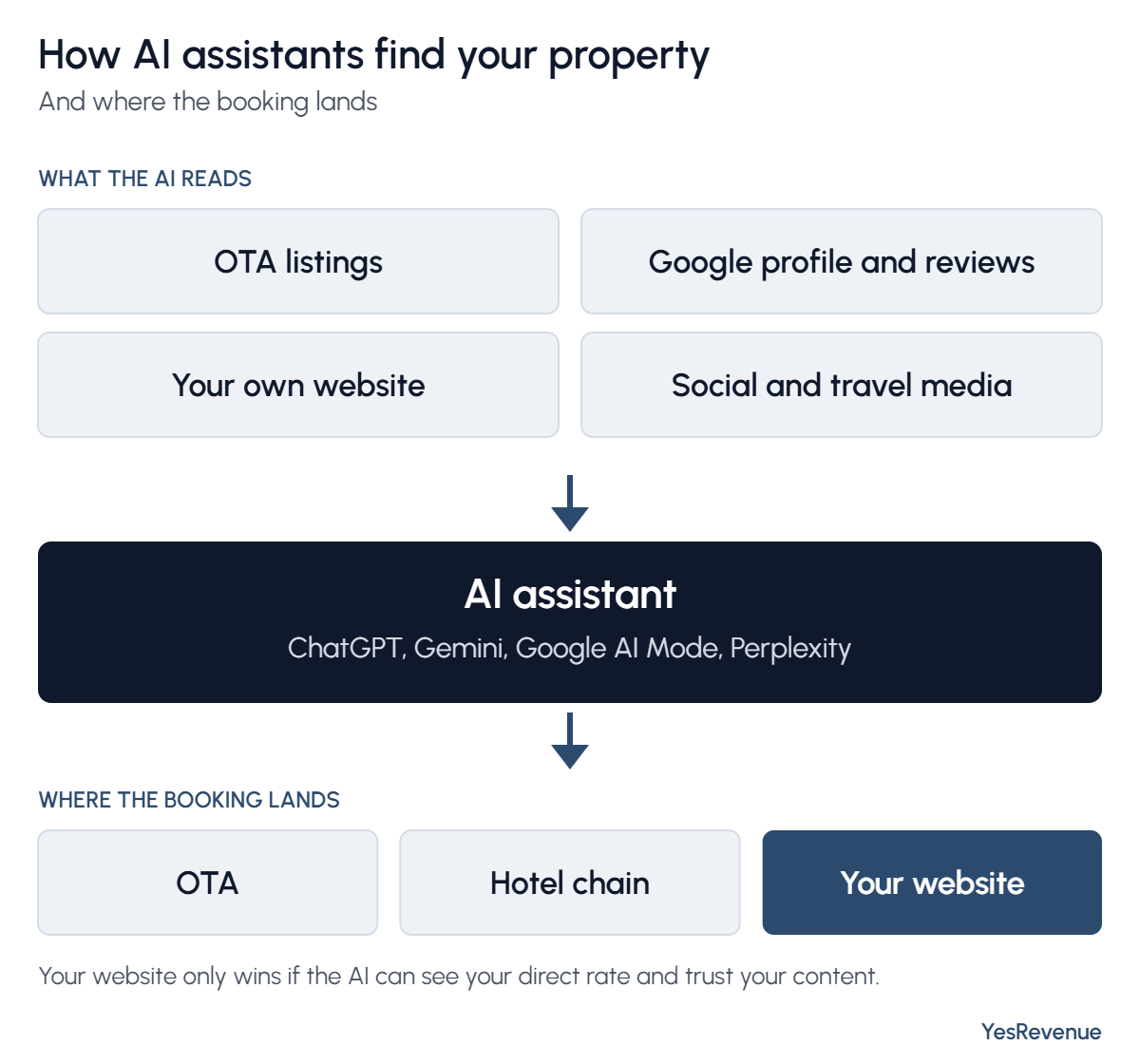
Notice who is plugged in first: the OTAs and the big chains. An independent property gets recommended through whatever the AI can read about it. In practice that means:
- Complete, consistent facts everywhere. Room types, beds, amenities, parking, pets, check-in times and policies should say the same thing on your website, your Google profile and every OTA.
- Fresh reviews, with replies. Assistants use reviews to explain why a place fits what the guest asked for.
- A website that is easy to read for machines and people. Clear room pages, real text instead of text inside images, fast on mobile.
- Your direct rate on Google. Free booking links again: if the AI can see a bookable direct rate, your website has a chance.
- A strong OTA profile. For now, many AI bookings will land on an OTA, so make sure that listing is the best version of you.
AI is useful on your side of the desk as well: first drafts of newsletters, ad variations, translations and answers to common questions. Keep a person in the loop before anything goes out, and keep guest data in tools that respect EU privacy rules.
And do not forget messaging. Many guests like to ask a quick question on WhatsApp before they book. A fast, friendly answer there converts better than most ads.
5. Price With a System
Pricing is where everything above comes together. A good pricing strategy weighs six things:
- Your history: seasonality, demand trends and the dates you sold out
- Business on the books: what is already reserved, and how it compares with last year
- Events and holidays: concerts, trade fairs, school holidays, anything that brings people to town
- Your segment mix: more corporate business than last year, a wedding request, a tentative group
- Your competitors: where they are priced, and whether they spotted an event you missed
- Pace and pickup: how fast new bookings come in, for which dates, room types and rates. This is one of the strongest demand signals you have.
None of this is a one-off exercise. Prices should follow demand every day of the year, within clear rules: floors, sensible steps between room types and minimum stays where they protect your best nights. Software can do the repetitive part. The judgement still needs a person who knows the property. We explain the mechanics in How Dynamic Pricing Works in Hospitality.
Your 2026 Checklist
- Know how every day of the year performs: occupancy, ADR and room revenue, against a target
- Run your own website and booking engine, and give guests a reason to book direct
- Get your direct rate onto Google with free booking links
- Define your competitive set and your advantages over it
- Set revenue targets per segment
- Be bookable on the channels your guests use, including local ones
- Use sharp, recent photos everywhere
- Track events and other demand drivers in your area
- Keep facts, reviews and content consistent, so AI assistants can recommend you
- Use a flexible pricing structure that follows demand, pace, competitors and your targets
- Stay active on Google, Instagram and Facebook, and answer messages fast
Can You Do It Yourself?
Yes. Everything above can be done in-house. The hard part is not doing it once; it is keeping it live and on target while you also run a property. If you would like a second pair of eyes on your numbers, book a free Performance Assessment Call.