

Every Monday we look at the same handful of numbers for every property we manage. Weeks before a month starts, they tell us whether it is on track, and what to do if it is not. Here is how we read them.
The Vocabulary
- OTB, on the books: what is reserved today for a future date or month.
- SDLY, same date last year: what was on the books for the same period at this point last year. It is a pace benchmark: it tells you whether you are ahead or behind, not where you will end.
- LY, last year: where the same period actually finished.
- Pickup: new bookings over the last day, week or two weeks, net of cancellations.
- FC, forecast: our best estimate of where the period will finish.
- TG, target: the number agreed in the budget.
- ATS, available to sell: your capacity minus rooms out of order; the base for occupancy.
And one rule we never break: every number carries its label. A total of 960 room nights means nothing until you know whether it is OTB, FC or TG.
Reading the Curve
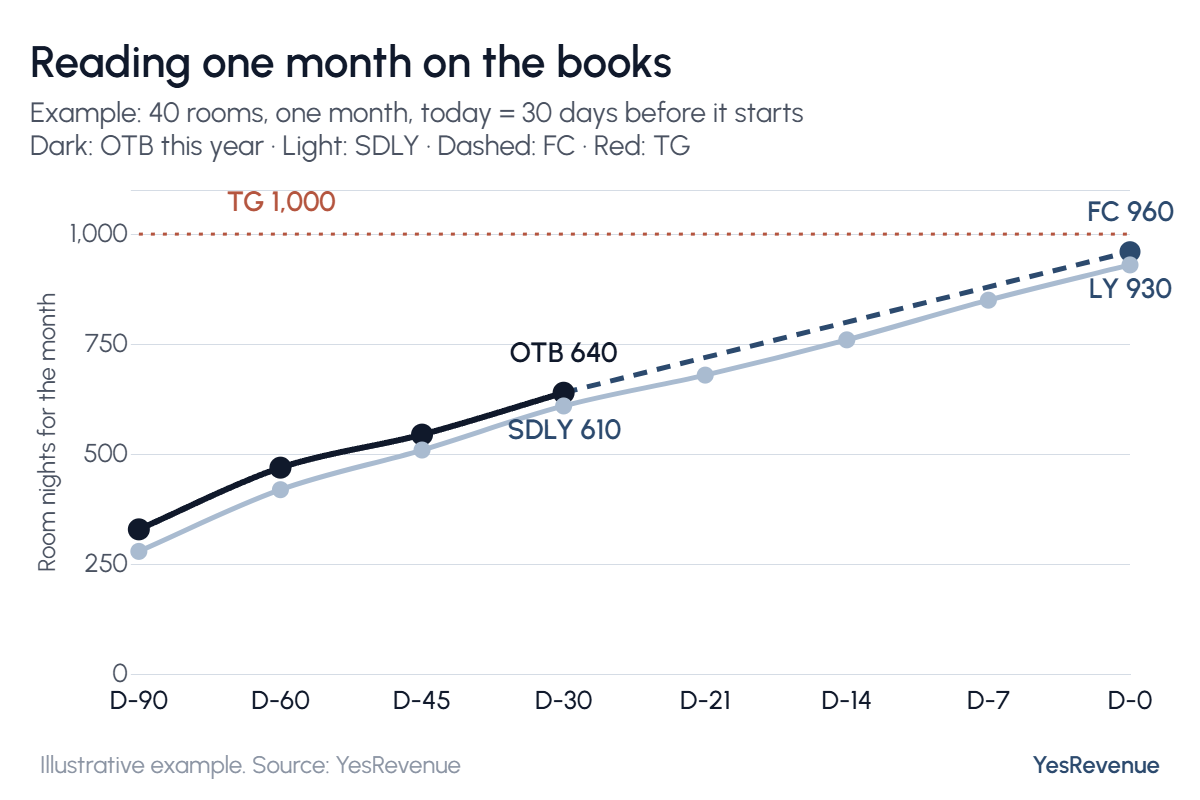
Thirty days before the month starts, this property has 640 room nights on the books. At the same point last year it had 610, so it is running 30 room nights ahead of last year’s pace.
Last year finished at 930. If this year picks up the same 320 room nights from here, it lands at 960, which is our forecast. The target is 1,000. Those missing 40 room nights are the real conversation: where can they come from, and at what price?
Why We Trust the Forecast More Than the Target
A target is set months in advance, often before anyone knows what the market will do. The forecast is updated every week from what is actually happening. Mid-year, we steer on the forecast and use the target as a reference, not the other way round.
Know Your Booking Window
Pace only makes sense if you know how your guests book. At some of the properties we manage, the median guest books six days before arrival, and only about one room night in five is booked more than a month ahead. For a property like that, a thin book in August for November is normal, not a reason to panic and cut prices.
Compare with your own SDLY, not with a gut feeling or a competitor’s calendar.
Pickup Tells You What Is Happening Now
Pace compares positions; pickup shows movement. We look at pickup over the last 1, 7, 14, 21 and 28 days, per month, per room type and per segment. A sudden jump for one weekend often means an event we missed. A week with no pickup at all, while last year was busy, is an early warning.
The Weekly Routine
- OTB against SDLY for the next three to six months, per month
- Pickup over the last seven days, and for which dates
- The forecast updated, with a note on what changed
- Rate and restriction changes for the dates that need them
- One short comment per month: on track, ahead or behind, and why
Once the data flows in automatically, this takes less than an hour per property. It is the habit that separates pricing from guessing.
Want us to run this check on your property? Book a free Performance Assessment Call.