

Most properties set their room type supplements once, often when the PMS was installed, and then forget about them. The family room is 30 EUR more than the double, the suite 50 EUR more, all year round. It works on an average Tuesday in March. On a sold-out Saturday in August, or a quiet Sunday in November, it quietly loses money.
Start From One Base Unit Type
Pick one unit type as the base, usually the one you have most of, and price it every day. Every other unit type follows the base through its supplement. That way you manage one price per day instead of ten, and the relationship between your rooms stays consistent.
Whatever method you use to calculate supplements, the values that end up in your PMS or channel manager should be absolute amounts in euros. Percentages are a way of calculating, not a way of loading.
Why a Straight Percentage Breaks
A percentage looks like the obvious answer: the family room is always 30% above the double. It works at normal rates. On your busiest nights it runs away.
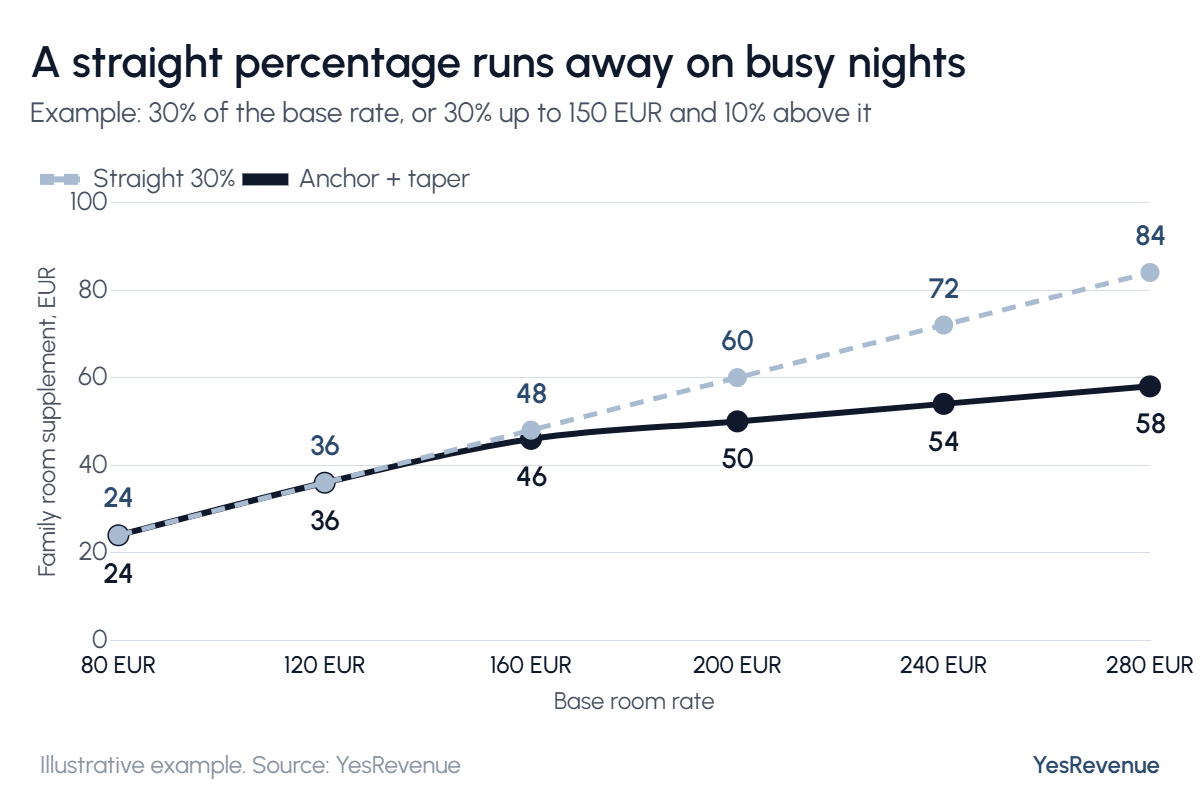
At a 280 EUR base rate, 30% means an 84 EUR supplement, and the family room suddenly looks expensive next to everything else in town. We use an anchor and a taper instead: the full percentage up to an anchor rate, and a smaller percentage on the part of the rate above it. With 30% up to 150 EUR and 10% above, the supplement still grows on busy nights, but stays believable.
Rules That Make a Ladder Hold
- Small steps between near-identical rooms. If your deluxe double is only slightly nicer than the standard one, a small but visible step of around 5% is enough. A big gap just pushes everyone into the cheaper room.
- Firm steps between classes. Between rooms and suites, or suites and apartments, keep a clear percentage step that does not shrink as rates rise. Guests should always see why the next category costs more.
- A floor per unit type. Besides the overall floor for the base, every unit type needs its own minimum, so a promotion never sells your best apartment below what it costs to run.
- Minimum and maximum steps. Decide how close and how far apart two neighbouring unit types may get, and the ladder can never fold or stretch into nonsense.
- Euros and percentages, where each makes sense. In a hostel, beds in different dorms differ by a few euros, while a private room is better priced as a percentage on top of a bed. One property can use both.
Let the Ladder Move With the Season
The order of your unit types is not fixed. Balcony and terrace units are worth more in summer, attic rooms more in winter. Family rooms earn their premium on summer weekends and in the school holidays, and struggle in low season. So we let the supplements breathe:
- In high season, push and protect the units you have few of. If you have one family suite, it should be the last unit you sell, not the first.
- In low season, bring larger units closer to the standard rate, to stimulate demand and move guests up.
- Closer to arrival, compress the supplements. Ten days out, an empty family room is worth less than a family room sold with a smaller premium.
An Example Ladder
| Unit type | Step | Low season | High season |
|---|---|---|---|
| Double (base) | Base rate | 90 EUR | 180 EUR |
| Deluxe double | +5% | 95 EUR | 189 EUR |
| Junior suite | +20% | 108 EUR | 216 EUR |
| Family room | 30% up to 150 EUR, 10% above | 117 EUR | 228 EUR |
Getting Started
Pull a year of data per unit type: occupancy, ADR and how early each type sells out. The unit types that fill first are underpriced against the base; the ones that go last are overpriced. Adjust, check again after a month, and repeat.
Want us to look at your ladder? Book a free Performance Assessment Call.