

Every revenue manager has a list of events somewhere. Most of those lists are a mess: a few concerts, the national holidays, last year’s trade fair with the wrong dates. A good events calendar is something else. It tells you which dates will be different, by how much, and what to do about it.
Build One Calendar, Properly
Keep one events database for every market you work in, with one row per occurrence and the same fields every time:
- Name and a short description
- Type: national holiday, school holiday, trade fair, concert, sports event
- Dates, plus lead and lag days, because guests arrive before a big event and leave after it
- Where it is observed: every country that celebrates it, not only where it is a day off
- Which of your markets it affects
- Expected impact, with a note on the source and how sure you are
Do not forget your feeder markets. For a property in Slovenia, school holidays and long weekends in Austria, Italy, Germany and Croatia often matter as much as the Slovenian ones. The same holiday can fall on different dates in different countries, so give each its own row.
Score the Impact Honestly
We score every event from -5 to +5, and the default is 0. An event only gets a high score when we are certain it moves demand. Then we check the scores against our own history: what happened on those dates last year, compared with a normal night of the same type.
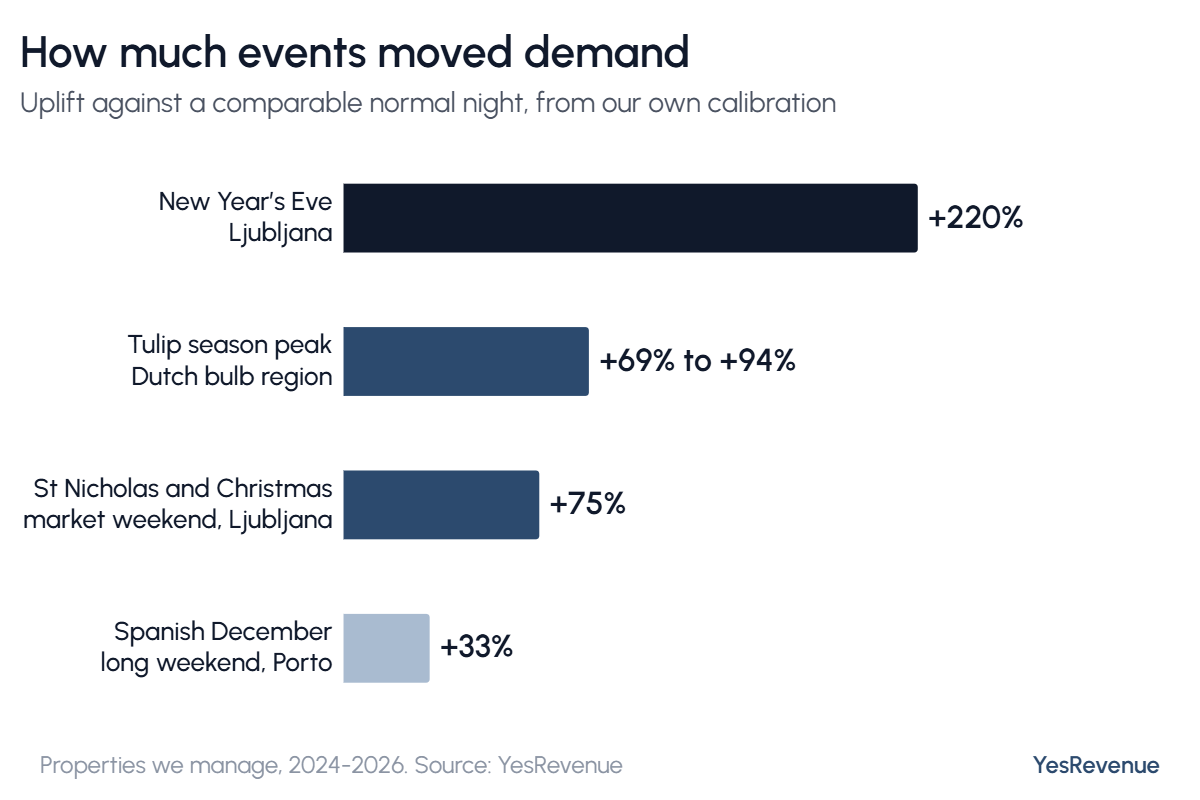
Some results surprise you. A Christmas market weekend that was missing from the original list turned out to be one of the strongest weekends of the winter. A famous festival turned out to be a three-night pattern rather than one big night. And some events everybody talks about barely move the numbers at all.
From Score to Price
An event should not trigger a random price jump. In our pricing it shifts the date into a higher season:
- A strong event moves the date up two seasons and a moderate one up one season. A negative event, such as a holiday when business guests stay at home, moves it down.
- The top season is the ceiling. When an event hits a date that is already at the top, a separate demand factor adds the extra pressure.
- Small events do not stack. Three minor events on one day should not add up to one big one, so only material events count.
- The effect spans a window: the day before and after, or a few days, depending on how guests travel to the event.
That keeps event pricing consistent and easy to explain, which matters when an owner asks why a Thursday in May costs twice as much as the Thursday before.
Keep the Quiet Signals Visible
Not every event matters for stay dates. Black Friday and Cyber Monday bring almost no extra guests on the day itself, but they are exactly when people book future stays. We keep them in the calendar as a reminder to launch an offer or check prices.
Low-impact events are marked inactive rather than deleted. Next year one of them might grow.
Keep It Alive
Build next year’s calendar in autumn and check it every month. Dates move: Easter falls on 28 March in 2027, more than a week earlier than in 2026. A wrong date in the calendar is worse than no date at all.
Want a demand calendar for your market? Book a free Performance Assessment Call.