

Do longer stays pay more per night? Is your non-refundable rate really cheaper than the flexible one? Do website guests pay more than OTA guests? The quick way to answer is to compare the average rate of each group. The quick way is also very often wrong.
The Problem: Mix
Averages hide when things happened. Longer stays and non-refundable bookings both lean towards summer, when every rate is higher. Compare their average ADR with everything else and you are partly comparing summer with winter, not long stays with short ones. A simple example:
| Mesec | 1-night stays | 3-4 night stays |
|---|---|---|
| March | 80 room nights at 50 EUR | 20 room nights at 56 EUR |
| July | 20 room nights at 100 EUR | 80 room nights at 112 EUR |
| All months pooled | 60.0 EUR | 100.8 EUR |
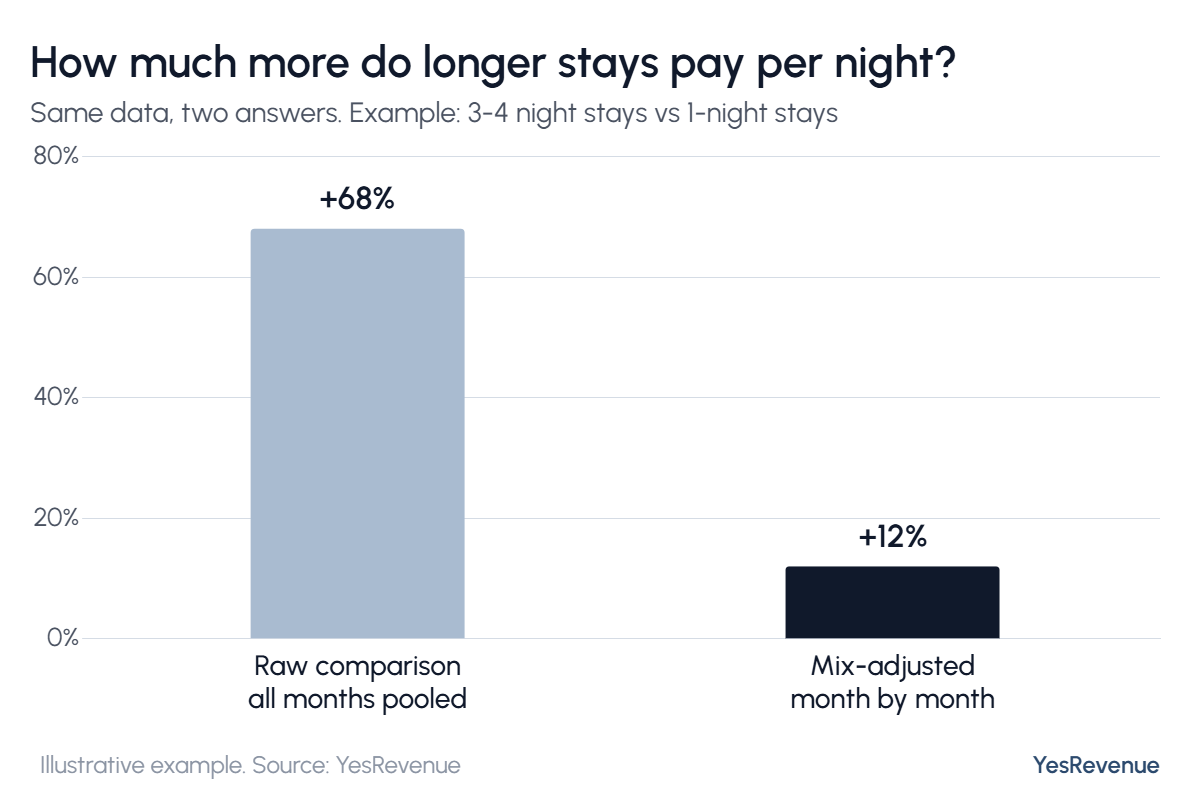
Inside each month, the longer stays pay 12% more per night. Pool the months and the gap jumps to 68%, simply because most long stays happen in July and most one-night stays in March.
How to Correct It
The fix has a long name, direct standardisation, and a simple idea: compare the two groups only where both exist, and give each period the same weight for both.
- Split the data into periods, usually months.
- Keep only the months where both groups actually sold.
- Calculate the ADR of each group within each month.
- Average those monthly figures, with the same weight per month for both groups.
- Report the raw and the corrected gap side by side. The difference between them is the mix effect.
In the example, the corrected ADRs are 75.0 and 84.0 EUR: a 12% premium, exactly what you see inside each month.
What It Changed in a Real Report
We ran into this in an owner report earlier this year. The raw numbers said guests staying three or four nights at a hotel paid 42% more per night than one-night guests, 75 EUR against 53. That looked like a strong case for minimum stays everywhere.
After the correction the picture was much calmer: 3-4 night stays earned about 12% more per night, stays of five nights or more about 10%, and two-night stays nothing extra. Most of the raw gap was season.
At a resort in the same portfolio the pattern ran the other way. Multi-night stays sold 20-28% below one-nighters, because a single night in a villa pays the full villa rate. A blanket minimum stay there would have cost money.
The same check changed our view of the non-refundable rate. The raw averages pointed in different directions at different properties. Corrected for the season mix, one property turned out to have no real non-refundable discount at all, while the others offered between 8% and 20%.
Where Else Mix Fools You
- Channels. If OTA guests book more in summer and direct guests more in winter, the channel ADR comparison is mostly season.
- Year on year. If Easter falls in March this year and in April last year, the monthly ADR comparison is partly calendar.
- Unit types. A unit type that is only open in high season will always look like the top performer.
- Segments. Groups often travel in the shoulder months, which makes their rates look worse than they are.
None of this means averages are useless. It means you should check the mix before you draw a pricing conclusion from them.
Want a second opinion on your own data? Book a free Performance Assessment Call.